

Automotive AHSS Market to Reach USD 49.59 Billion by 2035, Growing at 6.26% CAGR
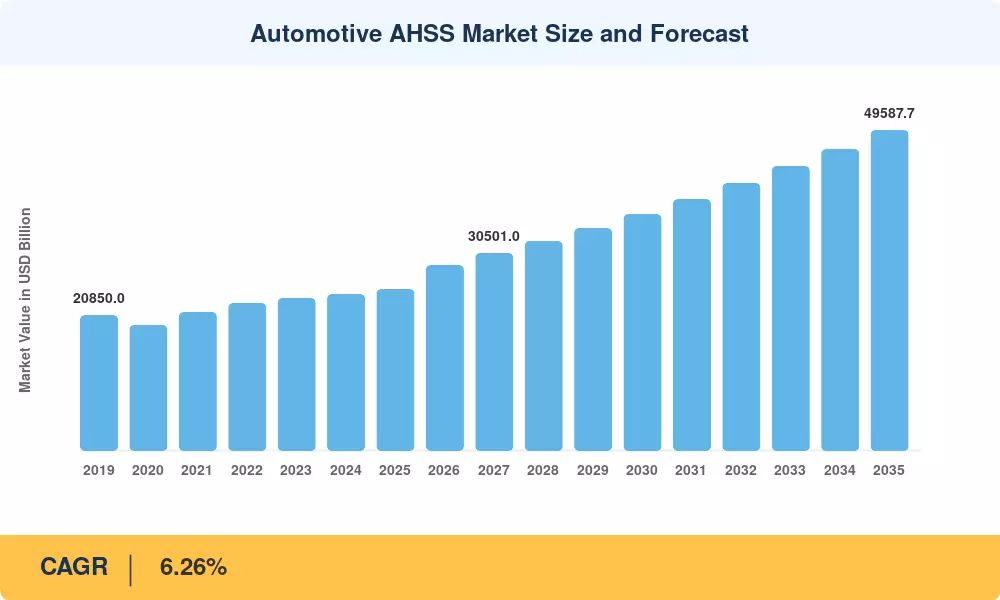
Automotive AHSS Market
Automotive AHSS Market projected to reach USD 49.59 Billion, at a CAGR of 6.26% during 2026 to 2035.
NEW YORK, NY, UNITED STATES, August 21, 2026 /EINPresswire.com/ -- According to a study from Market Research Future, Automotive AHSS Market projected to reach USD 49.59 Billion, at a CAGR of 6.26% during 2026 to 2035, driven by Growing demand for lightweight materials enhances opportunities in the Automotive AHSS industry.Market Overview
The Automotive Advanced High-Strength Steel (AHSS) Market represents a critical and growing segment within the global automotive materials industry, encompassing the development, production, and supply of advanced high-strength steel grades specifically engineered for automotive applications. Automotive AHSS refers to a family of steel grades that offer exceptional strength-to-weight ratios, superior formability, and excellent energy absorption characteristics, making them ideal for lightweighting vehicle structures while maintaining or enhancing safety performance. These advanced materials include various steel grades such as dual-phase (DP) steel, transformation-induced plasticity (TRIP) steel, complex-phase (CP) steel, martensitic steel, and press-hardened steel (PHS), each offering distinct properties suited for different automotive applications. The growing demand for lightweight materials enhances opportunities in the Automotive AHSS industry, as automakers seek to reduce vehicle weight to improve fuel efficiency, reduce emissions, and comply with increasingly stringent environmental regulations while maintaining structural integrity and crashworthiness.
The market's robust growth trajectory at a compound annual growth rate of 6.26% is underpinned by several powerful drivers. The most significant driver is the global regulatory push for improved fuel efficiency and reduced greenhouse gas emissions, which has compelled automakers to reduce vehicle weight through the adoption of lightweight materials. Advanced high-strength steels offer an optimal balance of strength, formability, and cost-effectiveness, making them the material of choice for many automotive structural applications. The increasing focus on vehicle safety and crashworthiness has driven the adoption of AHSS in safety-critical components such as passenger cells, crash management systems, and door intrusion beams. Furthermore, the cost competitiveness of AHSS compared to alternative lightweight materials such as aluminum and carbon fiber composites has maintained its position as the preferred lightweighting solution for mass-market vehicles.
Several significant industry trends are reshaping the Automotive AHSS landscape. The trend toward multi-material vehicle architectures, where different materials are used for different vehicle components based on their properties and cost-effectiveness, has created opportunities for AHSS in applications where strength, formability, and cost are critical considerations. The development of next-generation AHSS grades with improved formability and strength, including third-generation advanced high-strength steels, is enabling more complex vehicle designs and greater weight reduction. The trend toward electric vehicles, which benefit significantly from weight reduction to improve range and performance, has created additional demand for AHSS in EV-specific applications such as battery enclosures and structural components.
Technological developments in the AHSS sector are advancing steadily. The development of press-hardening steel, also known as hot-stamped or boron steel, has revolutionized automotive body structure design, enabling the production of complex, ultra-high-strength components with excellent dimensional accuracy. Advances in steel processing technologies, including improved rolling, annealing, and coating processes, have enhanced the properties and consistency of AHSS grades. The development of zinc-coated AHSS grades has improved corrosion resistance while maintaining the high strength and formability of the material. Furthermore, advances in joining technologies, including welding and adhesive bonding techniques specifically developed for AHSS, have facilitated the integration of these materials into vehicle structures.
Government policies and regulatory frameworks play a crucial role in shaping the Automotive AHSS market. Fuel economy and emissions regulations across major markets, including the Corporate Average Fuel Economy standards in the United States, CO2 emissions targets in Europe, and fuel consumption regulations in China, have been primary drivers of lightweighting and AHSS adoption. Safety regulations requiring improved crash protection have driven the use of AHSS in safety-critical applications. Government incentives for electric vehicle adoption have also contributed to AHSS demand, as lightweighting is essential for optimizing EV range and performance. Furthermore, government support for domestic steel production and advanced materials research has influenced the competitive dynamics of the AHSS market.
The demand outlook for automotive AHSS remains strong, with projections indicating sustained growth throughout the forecast period. The increasing complexity of vehicle designs and the need to balance strength, formability, and weight across vehicle structures drive continued demand for advanced AHSS grades. The commercial vehicle sector represents a significant growth area, with increasing adoption of lightweight materials in trucks and buses to improve payload capacity and fuel efficiency. The emerging electric vehicle sector presents substantial opportunities, as battery enclosures and structural components require high-strength, lightweight materials to maximize range and ensure battery protection.
📍 Get Free Sample Report for Detailed Market Insights:
https://www.marketresearchfuture.com/sample_request/4648
Market Segmentation
The Automotive AHSS Market is comprehensively segmented to provide detailed insights into the various dimensions of this critical and evolving materials industry.
By Application: The market is segmented into Body Structure, which represents the largest application segment for AHSS. Body structure applications include vehicle bodies, frames, and structural reinforcements that require high strength for crash protection and structural integrity. The use of AHSS in body structures has increased significantly as automakers seek to reduce weight while maintaining or improving crash performance. Chassis components represent a growing application for AHSS, with the material being used in suspension components, subframes, and chassis structures that require both strength and fatigue resistance. Safety Components, including door beams, bumper beams, side-impact beams, and seat frames, represent critical applications where AHSS provides the strength and energy absorption required to protect vehicle occupants during collisions. Energy Absorption components, including crash boxes and crumple zones, utilize the excellent energy absorption characteristics of AHSS to mitigate the effects of collisions and protect vehicle occupants.
By Manufacturing Process: The market is segmented into Hot Stamping, which involves heating steel blanks to high temperatures before forming and quenching in a die to achieve ultra-high-strength properties. Hot stamping is widely used for safety-critical components such as door rings, A-pillars, and bumper beams. Cold Stamping involves forming steel at room temperature and is used for components with complex geometries and moderate strength requirements. Roll Forming is a continuous bending process used to produce long structural components with consistent cross-sections, such as roof rails and sill reinforcements. Welding processes, including resistance spot welding and laser welding, are essential for joining AHSS components in vehicle structures, with specialized techniques developed to address the unique properties of AHSS.
By Vehicle Type: The market is segmented into Passenger Cars, which represent the largest and fastest-growing segment for AHSS, driven by high production volumes and the increasing use of lightweight materials in passenger vehicle structures. Light Commercial Vehicles represent a growing segment, with AHSS being used to reduce weight and improve payload capacity while maintaining durability. Heavy Commercial Vehicles are increasingly adopting AHSS in structural applications to reduce weight, improve fuel efficiency, and enhance crashworthiness.
By Thickness: The market is segmented into Below 1.5 mm, which includes thin-gauge AHSS used for outer body panels, closures, and interior components where formability and surface quality are important. The 1.5 mm to 3 mm segment encompasses intermediate thickness materials used for structural components and body reinforcements. Above 3 mm includes thicker AHSS used for chassis components, frame structures, and heavy-duty applications where higher load-bearing capacity is required.
🛒 You can buy this market report at:
https://www.marketresearchfuture.com/checkout?currency=one_user-USD&report_id=4648
Regional Analysis
North America represents a significant and mature market for automotive AHSS, driven by the region's large vehicle production base, strong regulatory focus on fuel efficiency and safety, and the presence of major steel producers and automotive manufacturers. The United States leads the region, with the Corporate Average Fuel Economy standards driving substantial demand for lightweight materials including AHSS. The region's strong focus on vehicle safety has driven the adoption of hot-stamped and advanced AHSS grades in safety-critical applications. The commercial vehicle sector in North America, including light trucks and pickups, represents a significant market for AHSS in structural and chassis applications.
Europe holds a substantial share of the global Automotive AHSS market, benefiting from the region's position as a center of automotive manufacturing excellence and its leadership in vehicle safety and emissions regulation. The European Union's stringent CO2 emissions targets have been a primary driver of lightweighting and AHSS adoption, with European automakers among the most advanced users of AHSS in vehicle structures. The region's strong focus on vehicle safety, reflected in Euro NCAP requirements, has driven the adoption of advanced AHSS grades in safety-critical applications. European steel producers have been at the forefront of AHSS development, establishing the region as a center of AHSS innovation.
Asia-Pacific represents the largest and fastest-growing market for automotive AHSS, driven by the region's dominant position in global vehicle production and the rapid adoption of advanced materials in automotive manufacturing. China, the world's largest automotive market and vehicle producer, represents the largest AHSS market, with strong demand driven by increasing vehicle production, regulatory pressure for fuel efficiency, and growing emphasis on vehicle safety. Japan and South Korea, home to major automotive manufacturers and steel producers, have been at the forefront of AHSS development and adoption. The region's rapidly growing electric vehicle market has created additional demand for AHSS in EV applications.
Rest of the World, including South America, the Middle East, and Africa, represents emerging markets with growing AHSS adoption. While these regions currently account for a smaller share of the global market, they offer substantial long-term potential as vehicle production expands and regulatory frameworks evolve. The commercial vehicle sectors in these regions represent significant opportunities for AHSS adoption.
Competitive Landscape
The Automotive AHSS market features intense competition among a diverse range of global steel producers, including integrated steel companies and specialized AHSS manufacturers. Key players include ArcelorMittal, SSAB AB, Nippon Steel Corporation, POSCO Holdings Inc., ThyssenKrupp AG, United States Steel Corporation, HBIS Group, Baosteel Group, Tata Steel Limited, and voestalpine AG. These companies compete on factors including product quality, material innovation, manufacturing capability, cost competitiveness, and relationships with automotive manufacturers.
Strategic developments in the market have been characterized by significant investment in AHSS research and development, the development of next-generation AHSS grades, and the expansion of production capacity in key regions. The trend toward third-generation AHSS, offering improved combinations of strength and formability, has been a focus for major steel producers. Strategic partnerships between steel producers and automotive manufacturers have become increasingly important, enabling collaborative development of materials optimized for specific vehicle applications.
Market positioning varies among players, with some companies focusing on specific AHSS grades or applications while others offer comprehensive AHSS portfolios across multiple grades and thicknesses. The ability to offer value-added services, including technical support, forming simulations, and joining expertise, has become increasingly important in differentiating AHSS suppliers in the competitive market.
Latest Industry News & Developments
Recent developments in the Automotive AHSS industry highlight the rapid pace of innovation and the strategic responses to evolving market demands. Major steel producers have announced significant investments in new AHSS production capacity, particularly in the Asia-Pacific region, reflecting the growing demand for advanced steel grades in automotive manufacturing. The development of third-generation AHSS grades, offering enhanced combinations of strength and formability, has been a focus of research and development efforts.
The industry has witnessed advancements in AHSS coating technologies, with zinc-coated and zinc-magnesium coated AHSS grades being developed to provide improved corrosion resistance while maintaining the high strength and formability of the base material. These developments are particularly relevant for exposed vehicle applications where corrosion resistance is critical.
Another significant development is the increasing focus on AHSS sustainability, with steel producers investing in low-carbon steel production technologies, including hydrogen-based direct reduction and electric arc furnace production using renewable energy. These developments are important for meeting the sustainability requirements of automotive manufacturers and for maintaining the competitiveness of steel as a lightweight material.
Market Challenges & Opportunities
Despite the strong growth prospects, the Automotive AHSS market faces several significant challenges. The higher cost of AHSS compared to conventional steel grades remains a barrier to adoption, particularly for entry-level and cost-sensitive vehicle segments. The lower formability of AHSS compared to conventional steel creates challenges in manufacturing complex vehicle components, requiring specialized forming techniques and tools. The challenges associated with joining AHSS, including welding and fastening, require specialized equipment and processes that can increase manufacturing complexity and cost.
However, these challenges are accompanied by substantial opportunities. The transition to electric vehicles presents significant growth opportunities for AHSS, as lightweighting is essential for optimizing EV range and performance. The development of new AHSS grades with improved formability and strength, including third-generation advanced high-strength steels, is enabling more complex vehicle designs and greater weight reduction. The growing emphasis on vehicle safety and crashworthiness continues to drive demand for AHSS in safety-critical applications.
Emerging opportunities also exist in the development of AHSS for specific applications, including battery enclosures for electric vehicles, where the material provides protection for sensitive battery components while contributing to overall vehicle lightweighting. The commercial vehicle sector, including heavy trucks and buses, presents opportunities for AHSS adoption in structural and chassis applications. The development of AHSS for emerging vehicle architectures, including skateboard platforms and autonomous vehicle structures, represents new growth opportunities.
To explore more market insights, visit us at:
https://www.marketresearchfuture.com/reports/automotive-ahss-market-4648
Final Market Summary
The Automotive AHSS Market is poised for sustained growth, projected to reach USD 49.59 Billion by 2035 at a compound annual growth rate of 6.26%. This growth reflects the fundamental importance of advanced high-strength steels in enabling the automotive industry to meet the dual challenges of improved fuel efficiency and enhanced vehicle safety.
The long-term industry potential remains strong, driven by the continued development of advanced AHSS grades, the increasing complexity of vehicle designs, and the growing demand for lightweight materials in conventional and electric vehicles. The transition to electric vehicles, in particular, presents substantial opportunities for AHSS adoption, as lightweighting becomes increasingly critical for optimizing vehicle range and performance.
Looking ahead, the market is expected to evolve with the development of third-generation AHSS grades offering improved combinations of strength, formability, and cost-effectiveness. The integration of AHSS with multi-material vehicle architectures will continue to create opportunities for steel producers who can develop materials optimized for specific applications. The competitive landscape will likely see continued consolidation and strategic partnerships as companies seek to position themselves for success in the evolving automotive materials market. Organizations that successfully develop and deploy innovative AHSS solutions that meet the demanding requirements of modern vehicle structures will be well-positioned to capture significant value in this essential and growing market.
More Related Reports from MRFR Library:
Automotive Lightweighting Market : https://www.marketresearchfuture.com/reports/automotive-lightweighting-market-11236
Electric Mobility Market : https://www.marketresearchfuture.com/reports/electric-mobility-market-11366
Electric Two Wheeler Charging Station Market : https://www.marketresearchfuture.com/reports/electric-two-wheeler-charging-station-market-11390
Buses and Coaches Market : https://www.marketresearchfuture.com/reports/buses-and-coaches-market-11467
Automotive Intake Manifold Market : https://www.marketresearchfuture.com/reports/automotive-intake-manifold-market-11531
Automotive OEM Market : https://www.marketresearchfuture.com/reports/automotive-oem-market-11536
Auto Parts Market : https://www.marketresearchfuture.com/reports/auto-parts-market-11564
Passenger Vehicle Telematics Market : https://www.marketresearchfuture.com/reports/passenger-vehicle-telematics-market-11740
Water Taxi Market : https://www.marketresearchfuture.com/reports/water-taxi-market-11939
Boat Rental Market : https://www.marketresearchfuture.com/reports/boat-rental-market-11959
Larry Wilson
WantStats Research And Media Pvt. Ltd.
+1 855-661-4441
email us here
Legal Disclaimer:
EIN Presswire provides this news content "as is" without warranty of any kind. We do not accept any responsibility or liability for the accuracy, content, images, videos, licenses, completeness, legality, or reliability of the information contained in this article. If you have any complaints or copyright issues related to this article, kindly contact the author above.
